

Physical AI is advancing quickly.
AI models can now recognize objects, plan actions, and adapt to new tasks. But despite this progress, most systems still struggle to scale in real-world environments.
Two core challenges explain why:
- Limited real-world dexterity
- High cost and complexity of deployment
Until these are solved, Physical AI will remain difficult to scale beyond controlled applications.
What is Physical AI?
Physical AI refers to AI systems that can perceive, decide, and act in the real world through physical interaction.
Unlike digital AI, Physical AI must handle:
- Uncertainty in the environment
- Variability in objects and materials
- Real-time feedback during physical contact
To work reliably, Physical AI systems must combine:
- Perception (vision, sensors)
- Decision-making (AI models)
- Action (robot motion)
- Adaptation (force and tactile feedback)
Why isn’t Physical AI scaling today?
Physical AI is not scaling because most systems:
- Struggle to handle real-world variability
- Require complex and costly integration
- Depend on precise conditions to function
- Lack real-time adaptability during interaction
In short, they work in demos, but not consistently in production.
The gap between Physical AI demos and real-world deployment
In controlled environments, everything is predictable.
In real-world applications, variability is constant:
- Parts are slightly different
- Lighting changes
- Objects shift during handling
- Contact forces are uncertain
This gap between controlled conditions and real environments is where most Physical AI systems fail.
Bottleneck #1: Real-world dexterity in robotics
What is robotic dexterity?
Robotic dexterity is the ability to manipulate objects reliably despite variation in shape, position, and physical properties.
This includes:
- Picking different objects
- Handling uncertain orientations
- Adjusting grip during motion
- Managing friction and deformation
Why is dexterity hard to achieve?
Most systems rely on:
- Precise positioning
- Detailed planning
- Limited feedback during contact
This makes them fragile when conditions change.
Common (but limiting) approach: more complexity
To improve dexterity, some systems add:
- Multi-fingered robotic hands
- Advanced grasp planning algorithms
- High-dimensional control
The problem:
More complexity often leads to:
- Higher cost
- Longer deployment time
- Lower robustness in production
A better approach: Simplifying robotic manipulation
Instead of increasing complexity, scalable systems simplify interaction.
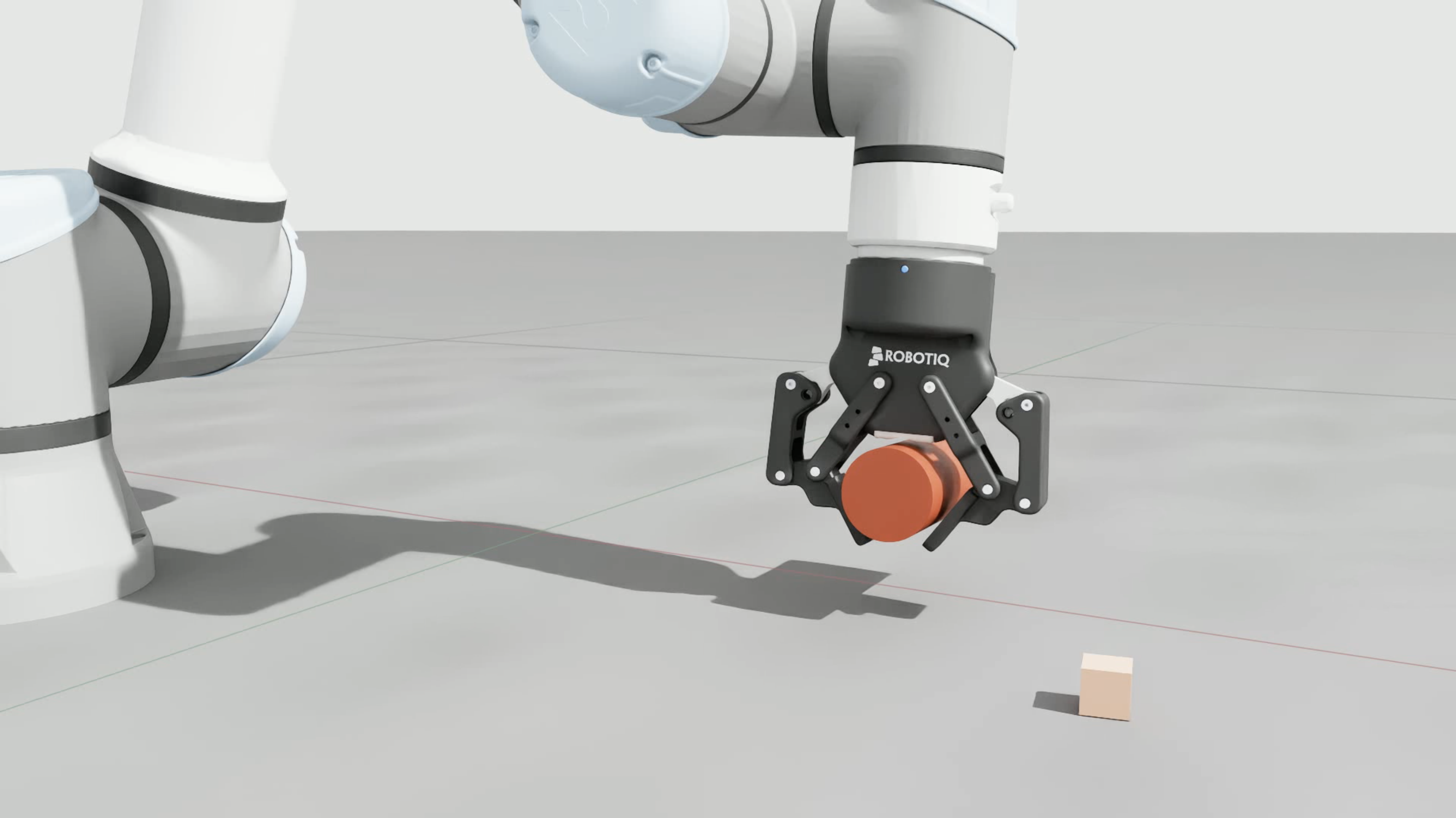
Adaptive grippers and compliant designs help by:
- Conforming to object shapes
- Absorbing positioning errors
- Reducing reliance on precise planning
Key idea:
Shift complexity from software to hardware.
This improves reliability without increasing system burden.
Bottleneck #2: Scaling Physical AI across deployments
Even when a system works once, scaling it is difficult.
Why is scaling robotic systems hard?
Because every deployment introduces variation:
- New product types
- Different layouts
- Changing lighting
- Operator differences
If each setup requires reprogramming or expert tuning, scaling becomes too expensive.
What makes a Physical AI system scalable?
A scalable system is one that can be deployed repeatedly with minimal effort.
Key characteristics of scalable robotics systems:
- Works across variation without major changes
- Requires minimal expert intervention
- Maintains consistent performance
- Has predictable deployment time and cost
Why repeatability matters more than capability
A system that works once is not enough.
The real value comes from systems that:
- Work consistently
- Can be replicated across sites
- Require little customization
Scalability = repeatability at a sustainable cost.
How to make Physical AI systems more scalable
To enable scaling, systems must be designed differently.
Best practices for scalable Physical AI:
- Design for variability, not perfect conditions
- Use sensing to adapt instead of pre-programming everything
- Reduce system complexity wherever possible
- Use hardware to absorb uncertainty
The goal is not to eliminate variability, but to handle it effectively.
The role of force and tactile sensing in Physical AI
Why is sensing critical for Physical AI?
Force and tactile sensing allow robots to:
- Detect contact in real time
- Adjust grip dynamically
- Handle uncertainty without reprogramming
This enables systems to adapt during execution—not just before.
How sensing improves scalability
With proper feedback, robots can:
- Generalize across different setups
- Reduce dependency on precise inputs
- Minimize manual adjustments
This is essential for scaling across applications.
From one successful robot cell to many
A scalable Physical AI solution is not defined by a single success.
It’s defined by how easily that success can be repeated.
If each deployment requires starting over, the system doesn’t scale.
The future of Physical AI: Simpler systems that scale
The next phase of Physical AI won’t be driven by more complex AI alone.
It will come from:
- Simpler, more robust system design
- Better integration of sensing and hardware
- Reduced dependency on ideal conditions
The systems that scale will be the ones that:
- Handle variability
- Deploy quickly
- Deliver consistent results
Closing thought: Physical AI must scale to deliver value
Physical AI has the potential to transform robotics.
But impact won’t come from isolated successes.
It will come from systems that scale across real-world environments.
From:
“What can this system do?”
To:
“Can this system scale?”
Because real impact comes from repeatable deployment rather than one-time performance.
Ready to make your robotics application scale?
If you're working on a robotics application and facing challenges with reliability, variability, or deployment at scale, you're not alone.
Talk to a Robotiq expert to explore practical ways to simplify your system, improve robustness, and move from a working concept to a scalable solution.
👉 Get in touch with our team to discuss your application


Leave a comment