
Tactile-Based Robot Centering as a Capability for Dexterous Manipulation
-modified.png)
A robot does not always grip a part exactly where intended. Vision may guide the gripper close, but camera calibration, part presentation, and positioning errors add up, causing the fingers to close slightly off the object’s center. The grasp may appear secure until the robot begins to lift. An offset between the grasp and the part’s center of mass creates a moment that can rotate the object within the fingers, changing its pose or causing it to slip entirely—a documented contributor to grasp failure.¹
Tactile sensing allows the robot to detect and correct this problem after contact is made. When an object is held off-center, contact forces are distributed unevenly across the fingertips. By measuring the full force distribution, not just the total gripping force, the robot can determine both that the grasp is unbalanced and the direction of the offset.
The robot can then adjust the position of its end effector and regrasp the object in a more balanced configuration. This reduces the moment caused by the offset from the object’s center of mass and limits the risk that the part will rotate or shift under load.
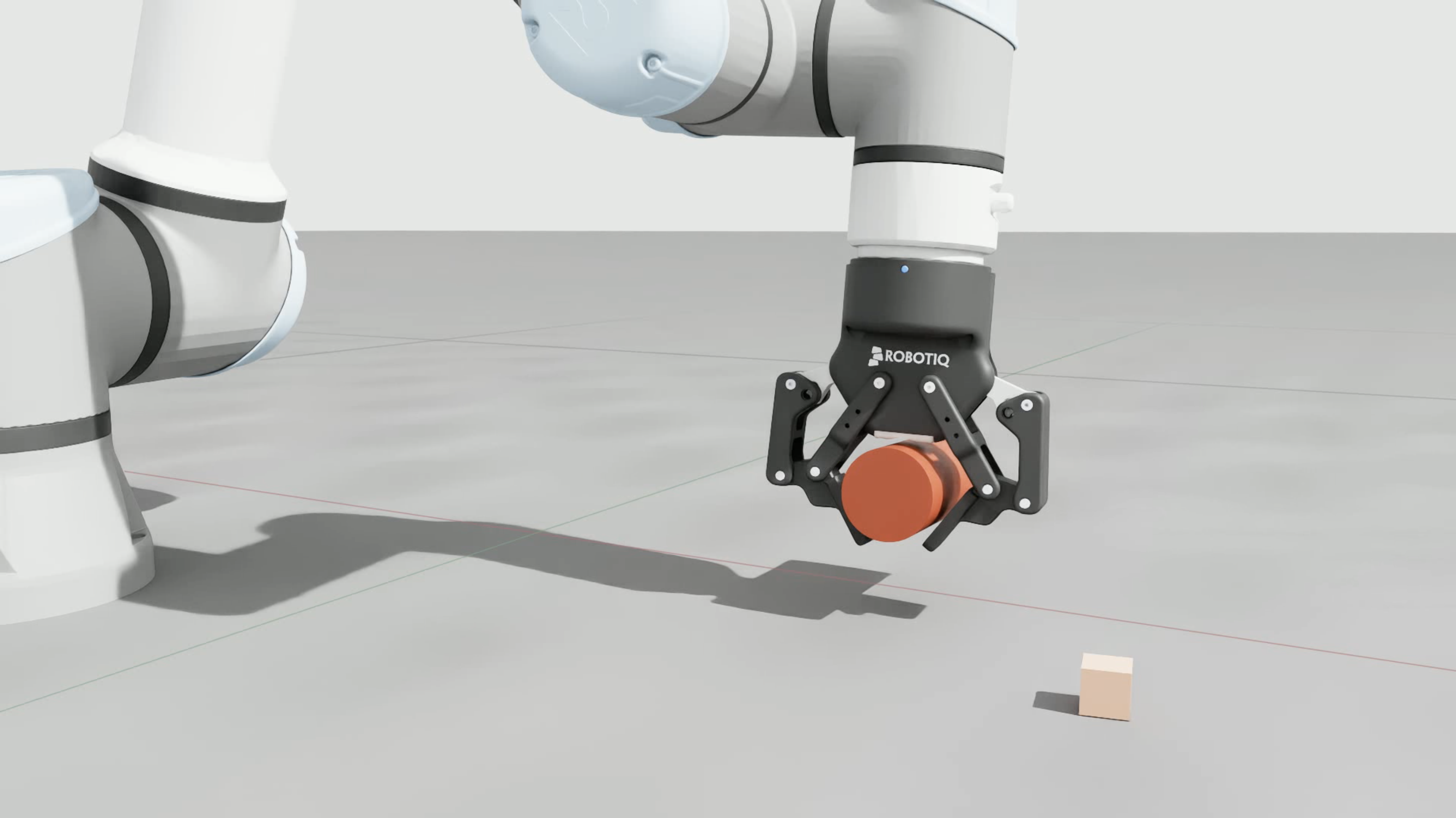
A recent demonstration at the Robotiq User Conference showed this loop in action. A 2F-85 gripper equipped with TSF-85 tactile sensors measured where contact force was concentrated across the fingertips. The robot used this information to reposition and regrasp the part until the load distribution was more symmetric—all using contact data, without relying on a vision system for the correction.
The payoff comes in the operations that follow. A balanced grip holds the object in a stable configuration and gives the controller a known starting pose, reducing reorientation, regrasping, and precision insertion to controlled adjustments rather than open-loop attempts. The capability extends what an existing cell can accomplish using contact-rich manipulation hardware.
Talk to our technical team about tactile integration for your manipulation pipeline, and learn more about how Robotiq can enable your application.
¹ Q. Feng, Z. Chen, J. Deng, C. Gao, J. Zhang, and A. Knoll, Center-of-Mass-based Robust Grasp Planning for Unknown Objects Using Tactile-Visual Sensors, 2020 IEEE International Conference on Robotics and Automation (ICRA), arXiv:2006.00906. The study reports a 31% improvement in grasp success rate from center-of-mass–aware regrasp planning.

Leave a comment