
Who Will Make Money in Physical AI?

Posted on Nov 18, 2026 in Physical AI
15 min read time
Billions of dollars are flowing into companies trying to build general-purpose intelligence for robots.
Take just five companies that announced major model-focused financings in 2026:
- Skild AI: $1.4 billion.
- Rhoda AI: $450 million.
- Generalist: $400 million.
- General Intuition: $320 million.
- Enigma: $71 million.
That's more than $2.6 billion invested this year in just five companies building different versions of intelligence for the physical world.
And there is more coming.
FieldAI, which describes its technology as a general-purpose brain that can operate across different robots and environments, recently signed a term sheet for a reported $700 million financing at a $10 billion valuation. The financing has not formally closed, so I don't include it in the $2.6 billion.
Clearly, investors believe Physical AI can become a very large market.
And I think they may be right.
But there is an important point hidden inside those valuations:
The math doesn't work yet with today's robot market.
For these investments to generate attractive returns, Physical AI cannot simply win share in the existing robotics industry.
It has to help make the robotics industry dramatically bigger.
That is where the story gets interesting.
Start with the robots entering the market today
According to the International Federation of Robotics, the United States installed almost 38,500 industrial robots in 2025. For perspective, China installed about 354,000, while Europe installed roughly 85,000 over the same period. Each region has its own robotics ecosystem, so for the rest of this analysis, I’ll focus on the U.S.
The existing installed base is not the right denominator for this exercise. Most robots already sitting in factories were never designed around today's foundation models and may never become customers for them.
So let's look only at new deployments.
Assume that a Physical AI model company can charge $3,000 per robot per year for its intelligence.
Now make an extremely favorable assumption: every new industrial robot installed in America uses the same model.
38,500 × $3,000 = $115.5 million of new ARR.
That's the entire annual U.S. industrial robot market.
Give that model company ten consecutive years of the entire market at today's installation rate, with every robot still paying, and you get approximately 385,000 robots producing $1.15 billion of ARR.
For one vendor. At 100% market share.
Today's industrial robot market isn't large enough yet to support the scale of value investors are underwriting.
That doesn't mean the investments are wrong.
It means investors are implicitly underwriting a very different future market.
What if robotics grows 100×?
Take U.S. installations from roughly 38,500 robots per year to 3.85 million.
At the same $3,000 per robot per year, one year's new deployments would create:
$11.55 billion of new model ARR.
Now the economics look completely different.
There is room for multiple major intelligence providers, robot platforms, application companies and infrastructure layers.
So behind the billions being invested in Physical AI is an assumption that I don't think gets discussed enough:
The technology has to expand the robotics market dramatically.
Maybe 10×.
Maybe 30×.
Potentially 100×.
The question isn't whether technology has ever created that kind of market expansion.
It has.
The more interesting question is what has to change in robotics for that expansion to happen.
Markets grow dramatically when technology removes a constraint
The largest technology-driven market expansions rarely happened because somebody built a product that was 20% better.
They happened when a new paradigm removed a fundamental constraint that had been suppressing demand.
Consider cloud computing.
Before cloud, getting more compute meant buying servers, installing infrastructure and predicting future capacity. Cloud didn't simply take market share from server manufacturers. It removed the requirement to own the infrastructure before consuming computing. Demand expanded.
Consider digital photography.
Film created friction around every photograph: film, processing, storage and a dedicated camera. Digital technology and eventually smartphones removed most of those constraints. The interesting outcome wasn't that consumers bought more traditional cameras. The underlying activity—taking pictures—became ubiquitous.
Or consider the smartphone itself.
Its importance wasn't simply that it created a better mobile-phone market. It made computing, cameras, navigation, payments, entertainment and communication continuously available to billions of people. Entire industries appeared on top of that change.
The common pattern is important:
Technology creates massive market expansion when it changes what is economically possible and when it removes adoption friction.
Which brings us back to robotics.
What is holding back robot adoption today?
There is certainly no shortage of physical work.
Walk through almost any factory, warehouse, construction site, laboratory, restaurant or hospital and you will find people performing physical tasks.
Yet comparatively few of those tasks are automated.
Why?
A major reason is that traditional automation requires engineering.
The application must be understood.
The cell has to be designed.
The robot needs to be programmed.
Variability has to be constrained.
Edge cases need to be engineered.
Integration needs to produce an acceptable return on investment.
This model works ok when the task is repetitive enough and the volume is high enough.
But it leaves an enormous long tail of physical work that remains uneconomical to automate and burdened by high friction to adoption
That is one of the constraints Physical AI is beginning to attack.
A general-purpose brain removes one major constraint
Imagine that instead of programming every behavior, a robot can understand a goal, perceive its environment, learn from demonstration and adapt when conditions change.
The economics of automation change fundamentally as programming friction disappears.
Tasks that could never justify weeks of engineering might justify a few hours of deployment.
A single robotic platform might address dozens of applications rather than one.
That can expand the market enormously.
And it explains why investors are willing to place such large bets on robot foundation models.
But there is an important second part to the equation:
A general-purpose brain does not automatically create a general-purpose robot.
Intelligence cannot change the payload of an arm.
It cannot extend its reach.
It cannot make an unreliable mechanical system reliable.
It cannot eliminate safety requirements.
It cannot eliminate maintenance.
And it cannot make an embodiment designed for one environment economically optimal in every other environment.
Physical AI can remove the programming constraint. It does not remove the embodiment or system-integration constraints.
That distinction matters enormously for where value will accrue.
General intelligence may initially live inside specialized bodies
Eventually, humanoids may provide an economical general-purpose embodiment.
If they become sufficiently capable, reliable and inexpensive, the combination of a general brain and a general body could unlock an extraordinary number of applications.
But that problem isn't solved yet.
In the meantime, we are starting to see something different:
pockets of generalization.
A smarter industrial arm can address a much broader family of manipulation tasks.
A mobile manipulator can solve many related warehouse workflows.
A dual-arm system can handle increasingly varied assembly and handling operations.
A construction robot can generalize across many situations while remaining optimized for construction.
A laboratory robot can become highly adaptable without needing legs.
The intelligence becomes increasingly general.
The embodiments remain optimized around economics and applications.
That creates several possible places to capture value.
So who actually makes money?
One obvious answer for our investors in the introduction is: the company with the best foundation model.
That may prove correct.
If a model works across many embodiments, improves rapidly with scale and becomes difficult to replace, the economics could be spectacular.
But it isn't the only possibility. Unlocking an application does not automatically mean you capture the value created.
It could accumulate in the infrastructure layer supporting foundation models—the compute, simulation, data pipelines and deployment tooling that make Physical AI usable at scale.
Value could accumulate in the robot platform if a particular embodiment becomes the standard way to deploy Physical AI (the core bet behind many humanoid investments).
It could accumulate in the sensory-motor layer, because intelligence only creates value if a machine can sense, react and interact reliably with the physical world in real time.
It could accumulate with whoever owns the strongest real-world data flywheel, where every deployed system makes the next deployment better.
It could accumulate in the application and deployment layer, where technology is ultimately converted into customer ROI.
And some companies will deliberately try to own all of these layers at once.
That full-stack strategy leveraging standard hardware and software building blocks may be particularly powerful in the short term.
When interfaces between the layers are immature, standards are still forming and customers want working outcomes rather than technology components. Packaging the brain, embodiment, application, deployment and data capture can make it much easier to deliver value.
It also lets a company capture more of the economics from each deployment.
That is one reason some of today's most ambitious Physical AI companies are not trying to become only a model provider or only a robot manufacturer.
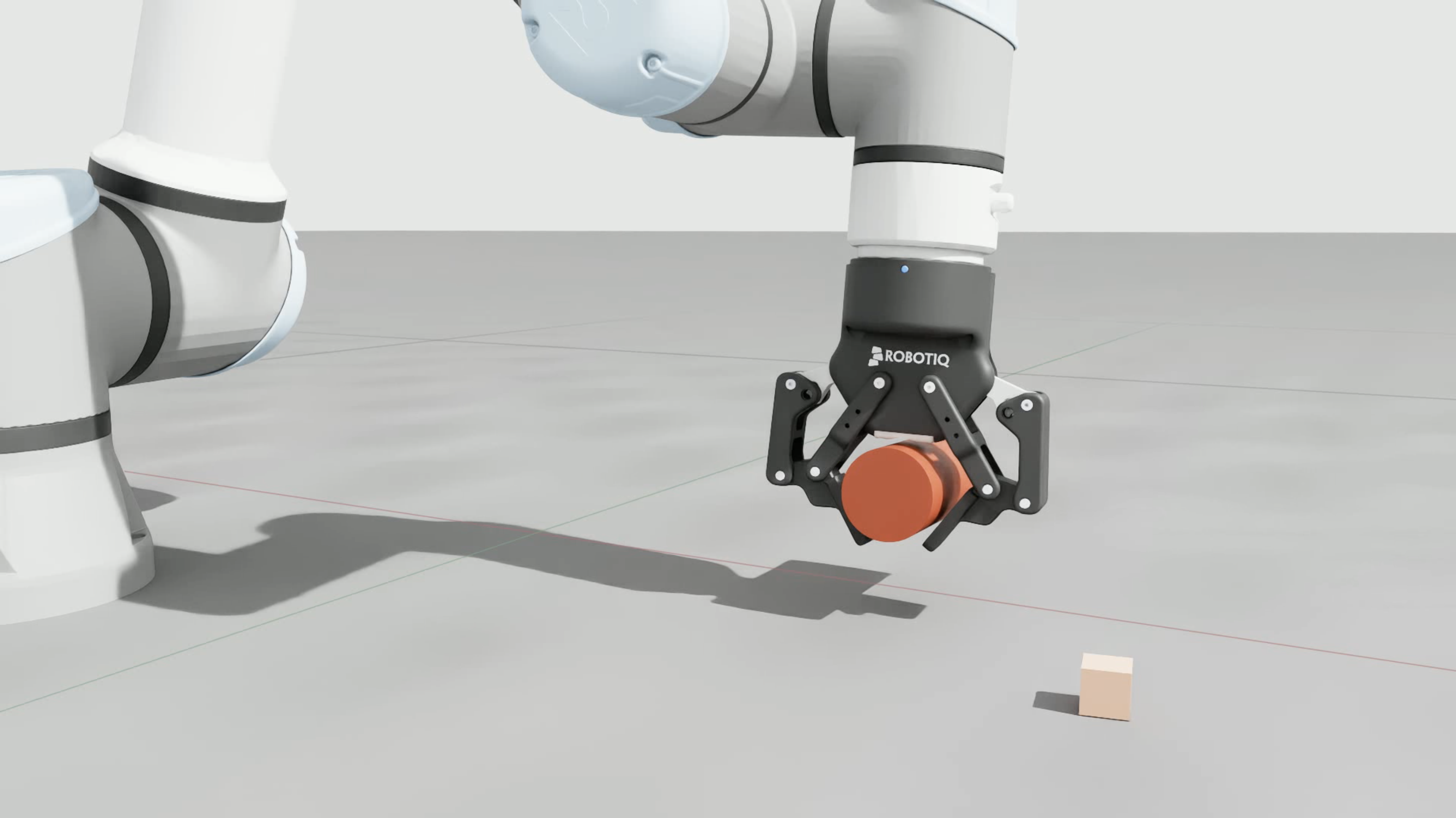
They are trying to productize the entire path from intelligence to productive work as quickly as possible, using deployments to accelerate their real-world data flywheel. Several are leveraging Robotiq components to move faster while maintaining industrial-grade reliability.
Follow the constraint
If Physical AI simply makes today's tens of thousands of annual U.S. industrial robot installations somewhat smarter, today's investment levels will be difficult to justify.
If it expands deployments into the hundreds of thousands, the economics change.
If it takes the market into the millions of new intelligent machines per year, we are no longer talking about an industrial-robot market.
We are talking about a new computing platform for physical work. One on top of which an entire ecosystem of hardware, software, applications and services can flourish.
I believe we are already on that path. We are seeing clear evidence of it in how our customers are deploying and scaling Physical AI.
A general-purpose brain could remove one of the biggest constraints holding robotics back today.
It just won't remove every constraint at once.
So, on top of asking:
Who has the best robot brain?
I think investors should ask two additional questions:
Which constraint is Physical AI removing now?
And then:
Once that constraint is solved, what becomes the next bottleneck preventing another 10× increase in adoption?
Sometimes the company solving that next bottleneck will be a specialist.
Sometimes it will be the same company going full stack.
Either way, follow the constraint.
Because there is a good chance that's where the next major pool of value in Physical AI will be created.
Data notes: 2025 U.S. industrial robot installations are from the International Federation of Robotics. Funding figures are based on company announcements and reporting for Skild AI, Rhoda AI, Generalist, General Intuition and Enigma. The FieldAI financing is reported from a signed term sheet and is not included as a completed financing.

Leave a comment