
Artificial intelligence can generate actions.
Physical AI hardware determines whether those actions succeed in the real world.
As foundation models expand into robotic manipulation, the bottleneck is no longer perception alone. It is physical interaction—contact, force regulation, slip detection, and adaptation to variability.
To deploy Physical AI at scale, robots need hardware that can sense, respond, and learn from real-world contact.
Why Physical AI hardware matters
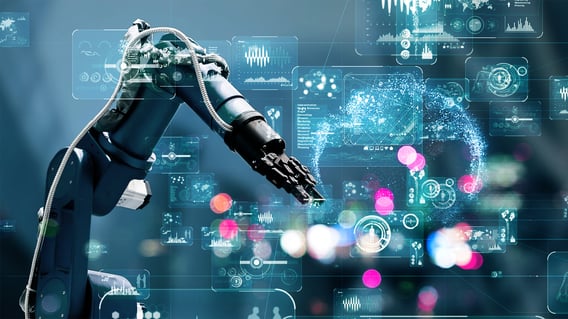
Simulation-trained models often fail at deployment because real-world interaction is uncertain:
- Objects vary in geometry and stiffness
- Contact forces fluctuate
- Slip and micro-collisions occur
- Environmental tolerances drift
Without high-quality physical feedback, manipulation becomes brittle.
Physical AI hardware provides the sensing and control layer required for:
- Closed-loop force regulation
- Contact-rich task execution
- Data collection for foundation model training
- Faster sim-to-real transfer
Adaptive Grippers for scalable robotic manipulation
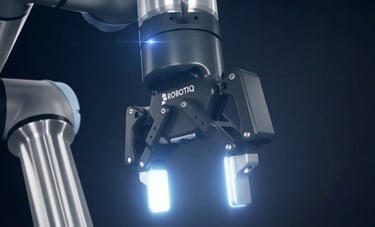
Adaptive grippers reduce grasp planning complexity through mechanical compliance.
Robotiq’s 2F-85 and 2F-140 conform to object variability, enabling robust manipulation without highly precise positioning or complex grasp policies.
With over 23,000 grippers deployed worldwide, they provide:
- Reliable encompassing grip in unpredictable environments
- Repeatable performance at scale
- Integration via standard industrial communication protocols
- High task coverage at sustainable cost
Mechanical intelligence simplifies the control problem before the model intervenes.
Tactile sensing for multimodal learning
Vision alone cannot resolve post-contact uncertainty.
The TSF-85 Tactile Sensor Fingertips provide multimodal tactile sensing:
- 28 taxels for pressure-based contact awareness
- 1000 Hz vibration sensing for slip detection
- IMU-based proprioception for finger orientation
This data improves grasp stability, enhances generalization across objects, and provides high-quality signals for robotic foundation model training.
For Physical AI systems, tactile sensing enables learning directly from interaction—not extrapolated from visual cues.
6-DOF force torque sensing for contact-rich tasks
Many industrial tasks require precise force control:
- Insertion
- Surface following
- Assembly
- Compliant manipulation
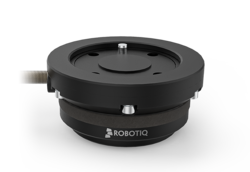
The FT-300-S 6-DOF force torque sensor delivers high-resolution interaction measurements that enable:
- Real-time force regulation
- Adaptive contact strategies
- Reduced tuning effort
- Faster recovery from disturbances
Furthermore, it does not need time-consuming or expensive calibration, and it has a high repeatability.
Force torque sensing is essential for scaling Physical AI beyond pick-and-place into complex manipulation.
Built for modern robotics and AI stacks
Physical AI development requires tight integration between hardware, simulation, and learning frameworks.
Robotiq supports this workflow with:
- ROS packages exposing gripper control, force torque data, and tactile signals as first-class robotics stack inputs
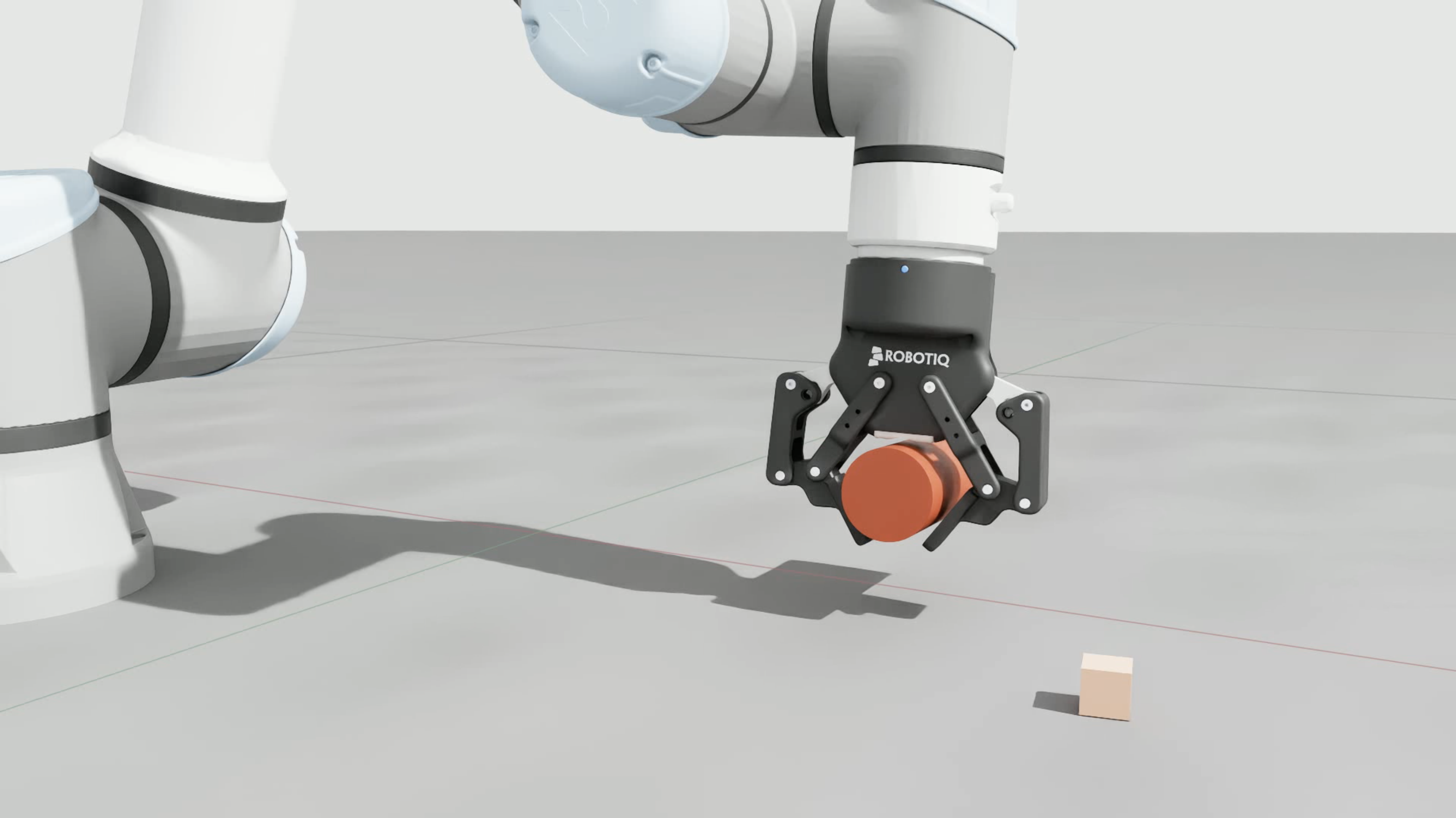
- NVIDIA Isaac Sim integration to bridge simulation and real-world deployment
This enables efficient data collection, model validation, and sim-to-real transfer.
Enabling scalable Physical AI
Two challenges define the future of Physical AI:
- Real-world dexterity
- Scalable deployment at sustainable cost
Physical AI hardware—adaptive grippers, tactile sensing, and force torque control—forms the foundation that connects AI models to reliable physical execution.
Without it, intelligence remains theoretical.
With it, AI becomes industry-ready.


Leave a comment