

Increasing output by 50% without adding floor space sounds unrealistic for most manufacturers.
That was the exact objective inside the production facility of Beyerdynamic, a German manufacturer of professional audio equipment and headphones. Leadership set a four-year plan: raise factory productivity by 50% while maintaining the same footprint and protecting strict quality standards.
No new building.
No compromise on acoustic precision.
No workforce reduction.
Here’s how collaborative robot automation made it possible.
The manufacturing challenge: Increase productivity in the same space
The bottleneck was a glue spraying application used to refine headphone loudspeakers acoustically.
Previously, skilled operators manually applied a medium directly onto the speaker membrane using a brush. While precise, the process introduced:
- Variability in application thickness
- Inconsistent quality results
- Limited cycle time improvements
- Ergonomic and safety concerns
Manual processes often become the limiting factor when manufacturers aim to scale production in constrained environments.
The team identified two automation opportunities:
- Handling the welded loudspeaker
- Spraying the acoustic medium
Collaborative robots quickly became the preferred solution due to their flexibility, compact footprint, and ease of integration.
The automation solution: collaborative robots with integrated vision
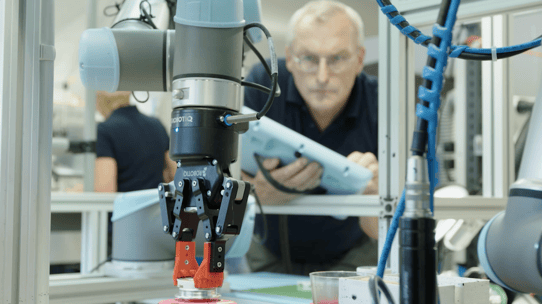
The company selected two UR5 collaborative robots from Universal Robots to build a synchronized robot cell.
To solve part handling challenges, they integrated:
Why vision systems matter in manufacturing automation
One universal challenge in manufacturing is part position variance. Components rarely arrive in exactly the same orientation.
In this case:
- Welded loudspeakers were placed within the camera’s field of view.
- The vision system recognized the speaker geometry.
- The gripper picked and positioned it precisely.
Engineers did not need to manually calculate coordinates. Instead, they physically guided the robot to teach positions. The plug-and-play integration reduced programming time and simplified deployment.
This combination of collaborative robots, robot grippers, and integrated vision enabled reliable picking of non-uniformly positioned parts — a common barrier to automation adoption.
Coordinated robot cell for handling and spraying
Once the first robot placed the loudspeaker onto a fixture, the second UR5 began the spraying process.
The automated sequence included:
- Even application of the acoustic medium
- Alternating spraying between two fixtures
- Automatic placement of completed speakers into trays
- Continuous coordination between both robots
The result was a fully synchronized robot cell performing handling, spraying, and staging operations.
Initial integration required refinement, particularly around spray precision and multi-robot timing. However, continuous optimization significantly improved cycle times.
Measurable results: 50% production increase and 50% quality improvement
Production officially began in July.
With the same three employees assigned to the station, the company achieved:
- 50% increase in production volume
- 50% improvement in quality index
- More stable and repeatable process performance
- Reduced variability in acoustic medium application
Consistent robotic spraying eliminated fluctuations inherent in manual brushing. Output delivery times improved while maintaining strict quality standards.
Importantly, the factory footprint remained unchanged.
For manufacturers searching for ways to increase production without expanding facilities, this case demonstrates how collaborative robot automation can unlock hidden capacity.
Human-robot collaboration in manufacturing
Successful automation is not only technical; it is cultural.
Leadership prioritized communication early in the project. Employees were invited to participate in the pilot program to reduce fear and encourage collaboration.
Operators were trained to:
- Start and monitor the robots
- Troubleshoot issues
- Restart systems independently
Instead of performing repetitive glue application, skilled workers shifted toward higher-value tasks where human expertise adds greater impact.
This approach reflects a broader manufacturing trend: automation reallocates human talent rather than replacing it.
Key takeaways
This case highlights several critical lessons for manufacturers evaluating factory automation:
- Collaborative robots enable production increases without expanding floor space
- Integrated vision systems solve part position variability
- Plug-and-play grippers simplify deployment
- Human-robot collaboration improves workforce utilization
- Measurable ROI can be achieved through process stability
For manufacturers facing space constraints, quality demands, and pressure to increase throughput, collaborative robot cells provide a practical, scalable path forward.
The transformation inside Beyerdynamic shows that significant productivity gains are possible — even within the same walls.


.png)
Leave a comment