

When you deploy something 850+ times, you start seeing patterns, not just in boxes and pallets, but in people, processes, and what really makes automation stick.
Across food and beverage, pharma, and consumer goods, our palletizing deployments have taught us a lot about what separates a “successful install” from a solution that keeps paying off year after year.
Here are five lessons that show up again and again and what they might mean for your own end-of-line.
1. The smoothest deployments start long before installation day
The fastest palletizing projects aren’t the ones with the simplest lines; they’re the ones where the application fit got nailed early.
Before any robot shows up, the most successful deployments take time to confirm:
- Box stability and consistency (weight, rigidity, surface, condition)
- Throughput targets (what the line actually runs today vs. what it should run tomorrow)
- SKU variability (number of patterns, case sizes, changeover expectations)
- Real end-of-line constraints (space, pallet access, infeed height, floor quality)
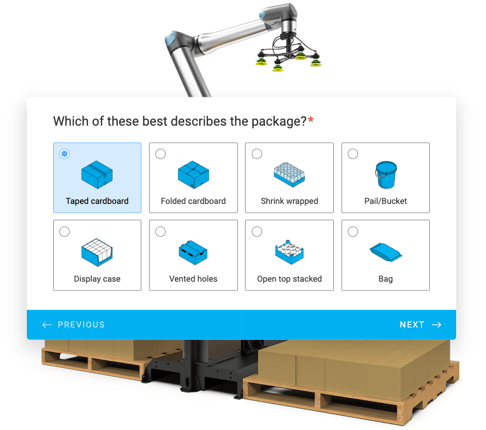
This is why we built tools and processes to qualify applications upfront. When the fit is right at the start, install goes faster, tuning goes smoother, and expectations are aligned from day one. That front-end clarity saves weeks later.
Takeaway: The best ROI doesn’t start with the robot. It starts with the right application decision.
2. Time-to-value beats “perfect on paper” specs
-1.jpg?width=500&height=281&name=Robotiq%20Background%20(Cascade%20Coffee)-1.jpg)
In the real world, customers don’t measure success by max payload or theoretical cycle time. They measure it by how quickly the palletizer becomes useful.
Across our deployments, the biggest wins come from:
- Short installation windows
- Fast ramp-up to production
- Simple handoff to operators
- A clear path from “first pallet” to “steady state”
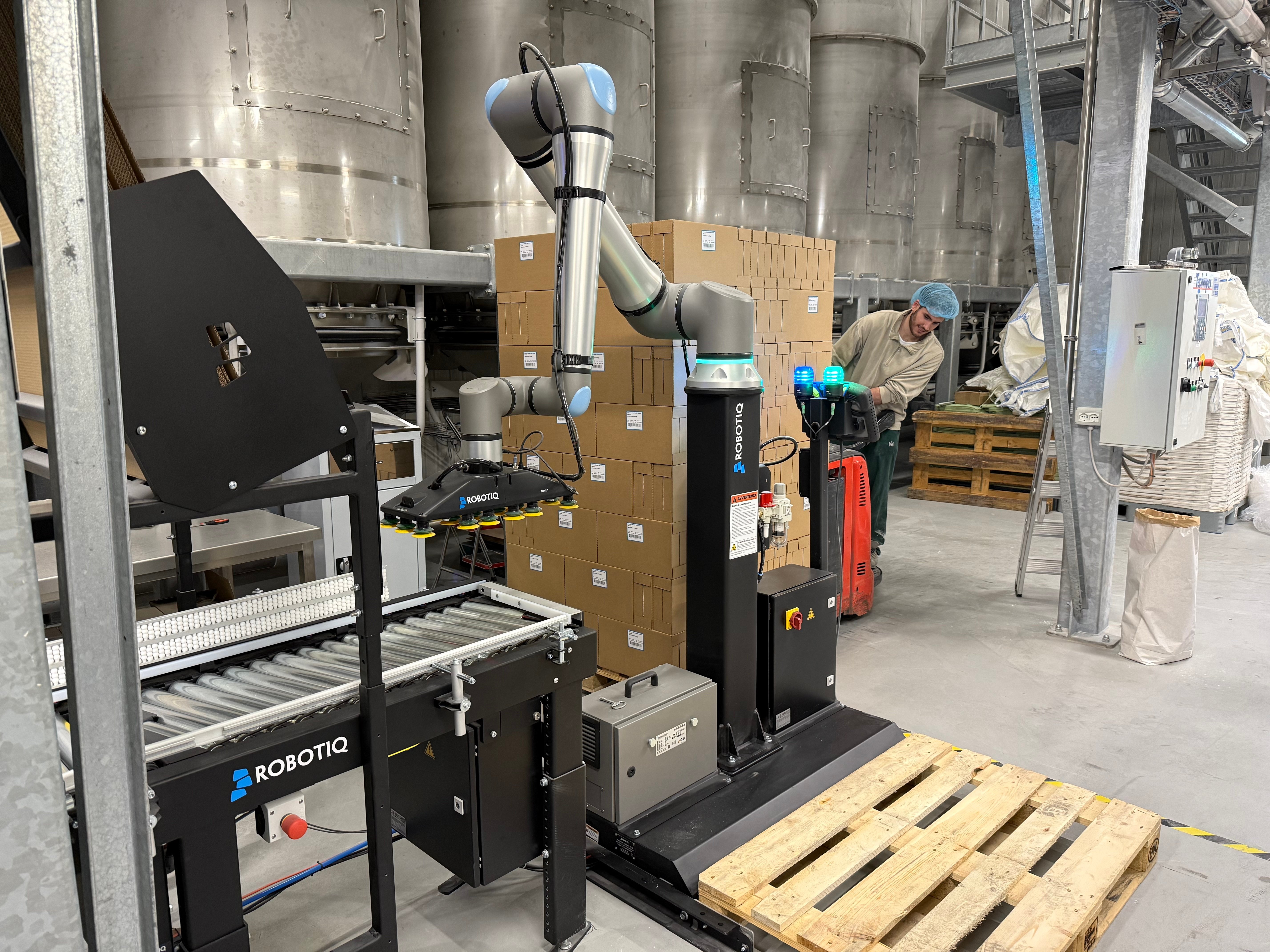
Most of our palletizing cells are installed and operational in just a few days — because what matters most is getting value on the floor quickly, not chasing an idealized setup.
That doesn’t mean ignoring performance. It means prioritizing what accelerates real production:
- the right layout
- a stable pick
- a safe, predictable flow
- and an installation process built for factories, not lab demos
Takeaway: The quicker a system creates value, the more momentum it has inside the plant.
3. Adoption succeeds when operators feel ownership
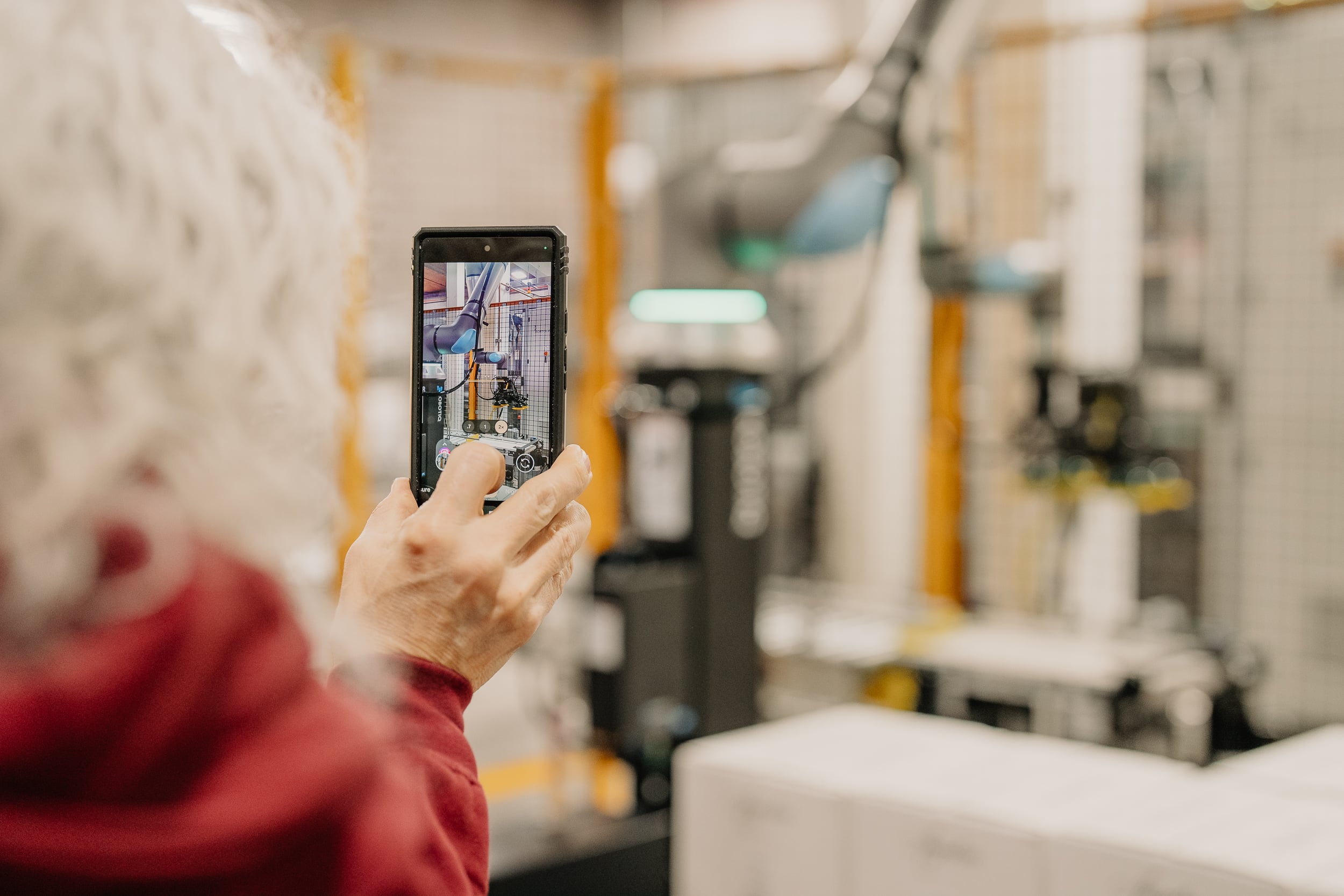
One of the most consistent truths we’ve seen: automation works best when operators take it personally.
The deployments that scale and stick almost always share a similar pattern:
- one or two operators become solution champions
- they learn the interface quickly
- they start making small adjustments on their own
- and soon the robot feels like “our tool,” not “their machine”
That ownership changes everything:
- issues get spotted early
- changeovers get faster with practice
- trust shows up in daily usage
- and teams start looking for where else automation can help
We’ve watched plants go from skepticism to pride in weeks — not because the robot is flashy, but because people feel confident running it.
Takeaway: A palletizer isn’t just a machine install. It’s a confidence install.
4. Flexibility is the value customers discover after go-live
Many deployments begin with a single goal:
“We just want to palletize this one line.”
But once the palletizer is running and the team is comfortable, something predictable happens:
- new SKUs get added
- more patterns get tried
- adjacent lines get considered
- usage expands quietly month by month
Flexibility turns out to be a sleeper feature. Customers don’t always buy for it — but they love it once they have it.
We routinely see plants start with one stable product, then scale to:
- multiple case sizes
- more mixed SKU schedules
- seasonal peaks
- or even second shifts without hiring stress
That phased growth reduces risk and spreads investment over time — which is exactly what Lean factories want.
Takeaway: The best deployments don’t just solve today’s problem. They unlock tomorrow’s options.
5. Real factories are messy. Design for reality, not perfection
You’ll never find a factory that matches the CAD drawing.
Some of our most useful lessons come from the “last 10%” — the moments where floor-level reality shows up:
- product variability
- damaged cartons
- wet cases
- pallet quality differences
- uneven floors
- unexpected line surges
The good news is: these are solvable. But they need to be expected.
The deployments that succeed fastest are designed to handle reality:
- grippers chosen for actual case conditions
- pallet patterns built for true box behavior
- layouts that allow real operator access
- and commissioning that includes fine-tuning on the floor
When we plan for messiness, uptime increases, and teams stop feeling like they’re babysitting the system.
Takeaway: A palletizer doesn’t need a perfect factory. It needs a factory-ready plan.
What this means if you’re considering palletizing automation
If there’s one thing 850+ deployments have made clear, it’s this:
Palletizing automation works when it fits the real world — your products, your line, your people, and your pace.
It doesn’t require a giant redesign.
It doesn’t require perfect cases.
And it definitely doesn’t require choosing between speed and simplicity.
It requires:
- the right application fit
- a fast path to value
- operator ownership
- room to grow
- and a design that expects reality
If you’re thinking about automation at end-of-line, start by pressure-testing the fit. A clear, early assessment makes everything easier downstream — from layout to ROI.
Curious if your line is a strong match?
Try the Palletizing Fit Tool or talk to our team for a quick evaluation. In a short session, we can validate feasibility, estimate ROI, and map a realistic deployment path.
Because after 850+ installs, we’ve learned this too: the best automation decisions are the ones you can make with confidence.




Leave a comment