

Pharmaceutical manufacturers are under pressure to increase output, maintain strict compliance, and protect their workforce, all within tightly controlled environments. Yet many facilities still rely on manual palletizing at the end of the line, where variability and risk are hardest to control.
As a result, more pharmaceutical manufacturers are adopting robotic palletizing as a standard part of their operations.
Rather than reacting to labor shortages, these companies are making a strategic shift toward automation to improve consistency, safety, and scalability.
So why do pharmaceutical manufacturers choose robotic palletizing?
Here are the five main reasons driving adoption.
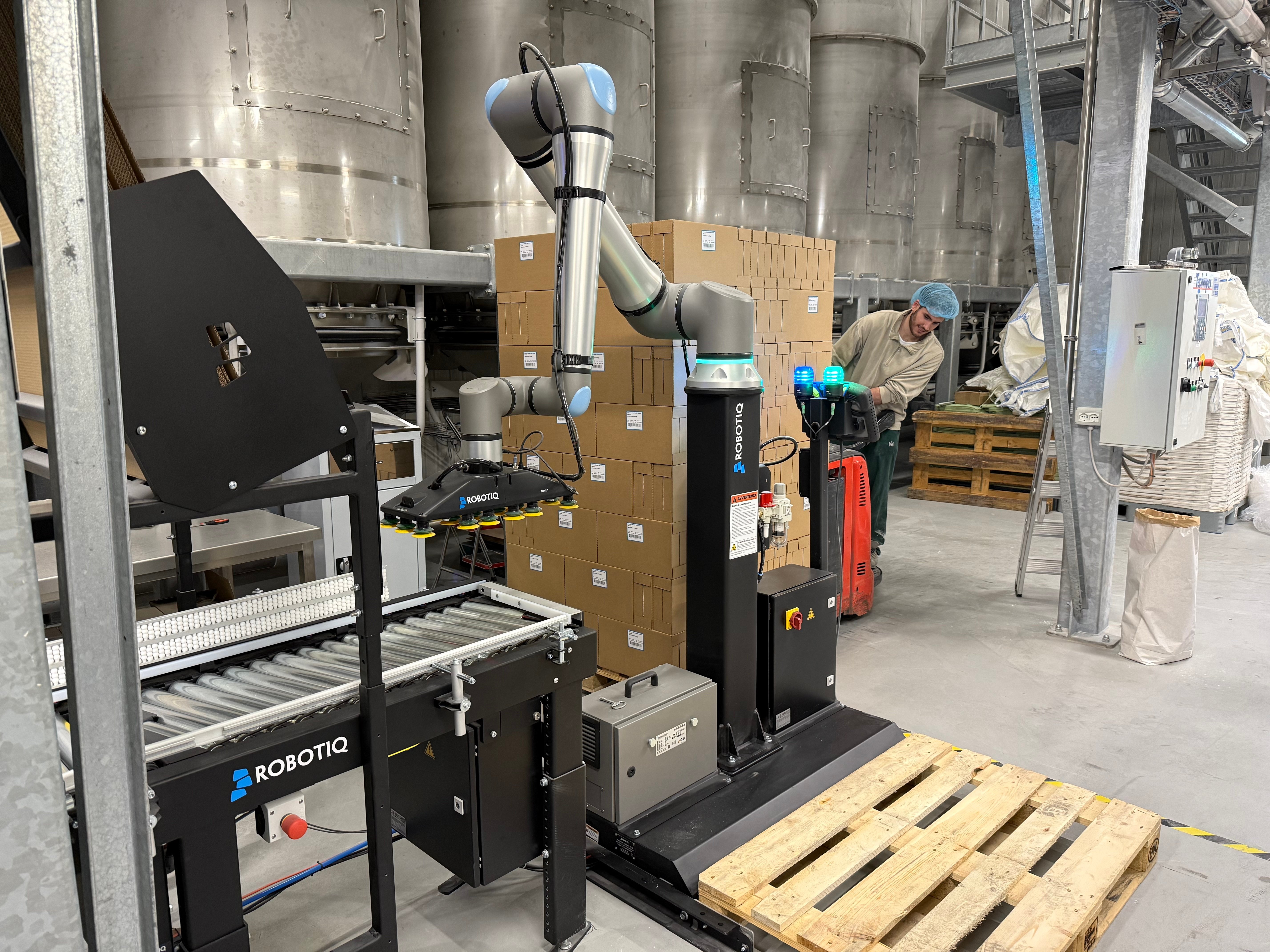
 Photo by Roberto Sorin on Unsplash
1. Building new production lines with robotic palletizing from day one
Pharmaceutical manufacturers are increasingly designing new production lines with robotic palletizing built in from the start.
Instead of retrofitting automation later, they:
- Plan palletizing alongside upstream processes
- Align automation with production ramp-up timelines
- Reduce integration risks and delays
This approach ensures that palletizing does not become a bottleneck as production scales.
2. Meeting validation and compliance requirements with consistent palletizing
In pharmaceutical manufacturing, every process must be repeatable and validated. Manual palletizing introduces variability that makes compliance harder to maintain.
Robotic palletizing helps manufacturers:
- Standardize pallet patterns and handling
- Maintain consistent cycle times
- Support validation with repeatable operations
For many teams, robotic palletizing is not just about efficiency—it is about ensuring the process meets regulatory expectations.
3. Improving worker safety with robotic palletizing systems
Manual palletizing is physically demanding and often performed in constrained environments. This increases the risk of injury and operational disruption.
Pharmaceutical manufacturers adopt robotic palletizing to:
- Reduce repetitive lifting and strain
- Improve safety in controlled environments
- Allow operators to focus on higher-value tasks
In many cases, improving safety is a key factor in gaining internal approval for automation projects.
4. Reducing implementation risk with proven robotic palletizing solutions
Even when the ROI is clear, pharmaceutical companies prioritize risk reduction before investing in automation.
To move forward, teams often require:
- On-site demonstrations
- Proven use cases in similar facilities
- Confidence in system reliability and validation
Robotic palletizing solutions that are simple, proven, and easy to deploy are far more likely to be approved and implemented.
5. Scaling robotic palletizing across multiple lines and facilities
Once a pharmaceutical manufacturer successfully deploys robotic palletizing, the next step is standardization.
Teams look to:
- Replicate the solution across production lines
- Standardize operations between facilities
- Simplify training and maintenance
This makes robotic palletizing a long-term strategy for improving productivity and adaptability across the organization.
From manual palletizing to scalable automation
Manual palletizing often becomes a hidden constraint in pharmaceutical manufacturing. It limits throughput, introduces variability, and creates safety risks.
Robotic palletizing transforms this process by enabling:
- Consistent, repeatable operations
- Safer working conditions
- Scalable production as demand increases
How to implement robotic palletizing in pharmaceutical manufacturing
To successfully adopt robotic palletizing, pharmaceutical manufacturers need solutions that are:
- Quick to deploy and easy to integrate
- Simple for operators to use without robotics expertise
- Compact enough to fit existing layouts
- Supported by local experts
Robotiq’s palletizing solutions are designed to meet these needs, helping manufacturers automate quickly while maintaining compliance and flexibility.
See how pharmaceutical manufacturers are closing the gap after serialization

Understanding why pharmaceutical manufacturers adopt robotic palletizing is one thing. Solving the challenges that come after serialization is another.
As serialization and aggregation become standard, many manufacturers struggle to maintain traceability and efficiency at the end of the line. This is where palletizing becomes a critical step—not just for handling products, but for preserving data integrity all the way to the pallet.
In our upcoming webinar with OPTEL, we’ll explore how pharmaceutical manufacturers are:
- Connecting serialization, aggregation, and palletizing into one continuous process
- Maintaining traceability from unit to pallet
- Eliminating end-of-line bottlenecks without compromising compliance
You’ll gain practical insights into how to design a palletizing process that supports both operational performance and regulatory requirements.
Save your spot for the webinar with OPTEL.





Leave a comment