![logo bleu-blanc2.png]](https://blog.robotiq.com/hs-fs/hubfs/logo%20bleu-blanc2.png?height=40&name=logo%20bleu-blanc2.png)
Humanoid robots used for order processing or kitting often have to move plastic containers. Depending on what they hold, these containers can weigh anything from 500 g to well over 10 kg, and no single way of grabbing them works across that whole range.
This article explains how a humanoid robot can adapt its handling strategy to the weight of the container, and where Robotiq grippers fit in.
Human-Like Strength, Human-Like StrategiesHumanoid robots are built to take over tasks usually done by people, so they share roughly the same proportions and the same strength. A good way to plan their handling strategy is to look at how a person handles a load as it gets heavier:
| Handling mode | Comfortable load | Upper limit | How the load is carried |
|---|---|---|---|
| One hand | About 5 kg | About 10 kg |
The upper limit can only be held briefly and with strain. |
| Two hands | About 10 kg | About 20 kg |
Both hands share the load, which makes 10 kg easy to handle. |
| Forearms | About 20 kg | About 30 kg |
The load rests on the forearms, close to the body, and the torso and core take part of the effort. |
| Back | About 30 kg | About 50 kg | The weight is spread across the back and carried by the strongest muscles of the body and legs. |
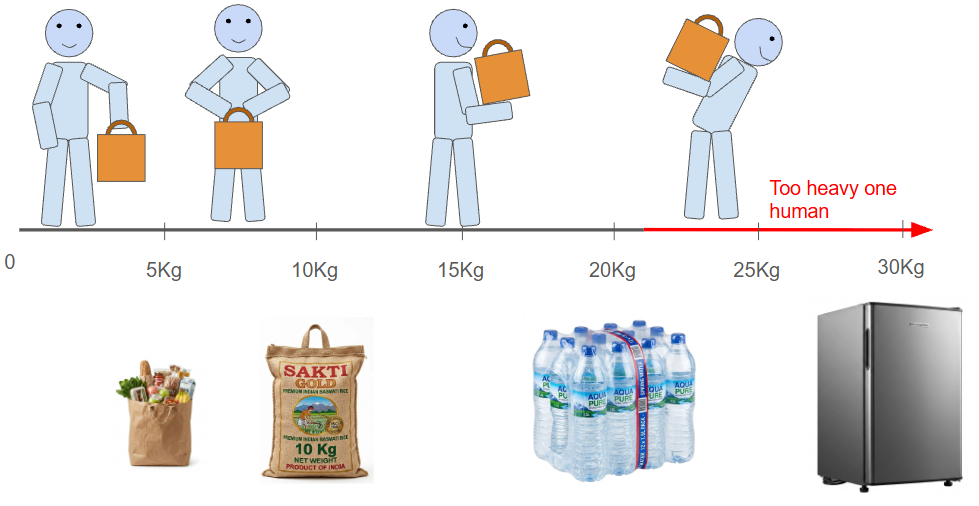
These values are general approximations for an adult and are given only to illustrate the principle.
People switch from one mode to the next as the load gets heavier, and a humanoid robot should do the same.
Matching the Strategy to the Container WeightContainers up to about 10 kg: grip with two grippers
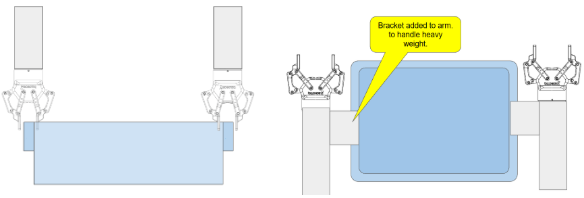
For light and medium containers, the robot can grip the container with a gripper on each hand. With two Robotiq grippers, the combined capacity is:
- 2F-85 Adaptive Gripper: up to 5 kg per gripper, or about 10 kg for the pair.
- Hand-E Adaptive Gripper: 7 kg nominal payload per gripper, or about 14 kg for the pair.
These are the values given in the product manuals. The actual payload depends on the grip type, the fingertips and the robot's acceleration, so always validate it with the payload calculation in the gripper manual before going into production.
Containers above 10 kg: carry with the arms
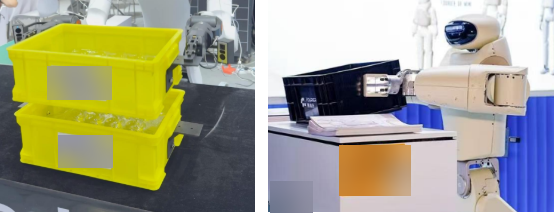
Once the container gets heavier, the robot stops relying on its grippers alone and carries the container on its arms, the same way a person moves from a two-hand grip to the forearms. Containers fitted with brackets make this much easier, because they give the robot a solid and repeatable place to support the load.
Note: Using a gripper with a higher payload to lift a heavy container is not recommended. The grip force needed to hold the load can damage the container, and a dropped container is a safety hazard for the people working nearby.
ConclusionA humanoid robot handles plastic containers best when it adapts its strategy to their weight: two grippers for loads up to about 10 kg (14 kg with Hand-E), then its arms for anything heavier. To pick the gripper that suits your containers, see Choosing the Right Gripper for Your Application.
Need help? Contact Robotiq Support.
Updated: October 26, 2026