![logo bleu-blanc2.png]](https://blog.robotiq.com/hs-fs/hubfs/logo%20bleu-blanc2.png?height=40&name=logo%20bleu-blanc2.png)
Context
This article outlines the main risks commonly encountered in robotic palletizing applications and presents general mitigation guidelines. It is meant to support, not replace, a formal risk assessment. Only a documented and certified risk assessment process can ensure the safe deployment of robotic systems.
Information
Main risks in palletizing applications
There are two primary risks to address:
1. Contact between the robot system and a person
Even collaborative robots can pose a hazard during interaction. Built-in safety features should be configured appropriately:
-
Reduced robot speed
-
Limited applied force
-
Retraction or stop in case of contact
Recommended safety parameters:
-
Maximum speed: 1 m/s
-
Maximum force at the tool: 140 N
Impact on cycle time :
-
Collaborative settings impact the achievable pick rate due to safety limitations on speed and force. You can use the following guideline zones:
-
Green zone: Up to 6 picks per minute
Safe and reliable within collaborative mode -
Yellow zone: Between 6 and 8 picks per minute
Possible under optimal conditions (no extra moves, no contact detection)
To ensure stability, we recommend using multi-pick tools -
Red zone: Above 8 picks per minute
Typically unrealistic in collaborative mode
To reach this rate, consider:-
Using non-collaborative parameters
-
Adding external safety devices to maintain compliance
-
-
2. Box projection toward a person
Assumptions for collaborative applications:
-
Boxes are made of cardboard or other soft materials
-
The robot uses vacuum-based end-of-arm tooling, which reduces mechanical impact
These conditions are generally compatible with collaborative use.
However, certain applications may not qualify:
-
Palletizing rigid or breakable items, such as glass bottles, introduces higher risk
-
These scenarios are likely to be non-collaborative and must be addressed specifically in the risk assessment
Our analysis
Falling or projected boxes present a serious risk, especially in these situations:
-
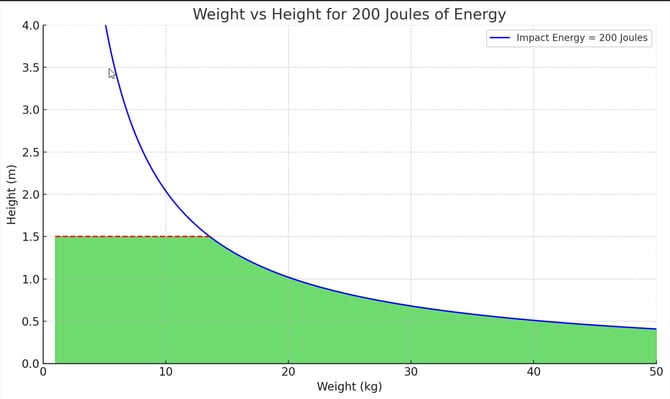
Contact with the head, especially if the pallet height exceeds 1.5 meters
-
Contact with the feet, with energy above 200 Joules
This energy level corresponds to the standard impact resistance of safety shoes rated under EN ISO 20345.
This formula to estimate impact energy:
E = m × g × h E = energy in joules /m = object mass (kg) /g = gravity (9.81 m/s²) / h = height from ground (m)
Collaborative-compatible cases in our Robotiq experience
A setup can generally be considered collaborative-compatible if:
-
The maximum stack height is under 1.5 meters to prevent head contact
-
The impact energy from a dropped box is less than 200 Joules to prevent feet contact on safety shoes
Any condition outside this zone must be addressed in the risk assessment and may require additional measures.
Additional risk mitigation: PPE
Personal protective equipment should be evaluated as part of the risk assessment. Typical examples include:
-
Safety glasses
-
Protective footwear
-
Helmet or bump cap
Conclusion
In palletizing applications, the main risks involve human–robot contact and box projection. Collaborative features and safe design parameters help define acceptable zones, but only a complete risk assessment ensures proper safety. Always validate your installation with certified safety processes.
Need help? Contact us at https://robotiq.com/contact
Updated: January 2026