![logo bleu-blanc2.png]](https://blog.robotiq.com/hs-fs/hubfs/logo%20bleu-blanc2.png?height=40&name=logo%20bleu-blanc2.png)
This article confirms the compliance of the Robotiq Hand-E Gripper with the new ISO 10218-2:2025 standard for industrial robot applications. The update released by the International Organization for Standardization (ISO) in 2025 to ISO 10218-2 incorporates the former ISO/TS 15066, specifically integrating the force and speed limits designed to stay below human pain thresholds in collaborative applications. Ensuring compliance with these force thresholds is critical for safe deployment in human-robot environments.
- Overview of ISO 10218-2:2025
- The updated standard includes the requirements previously found in ISO/TS 15066 on the maximum permissible quasi-static forces in a Power and Force Limiting (PFL) collaborative application.
- These values are now located in Annex M; for instance, the maximum quasi-static force for hands and fingers is specified at 140 N. While Annex M is classified as “Informative” rather than “Normative”, adhering to these limits has become the industry benchmark for streamlining safety validation and ensuring worker protection.
- Purpose of Compliance Verification
- Collaborative applications involving human contact require proof that tools like the Hand-E Gripper do not exert excessive force on the worker.
- The maximal grip force of a gripper cannot be used for the validation, since the force transfer to a body part will be lower due to damping.
- A specific test must be done to ensure user safety and alignment with evolving industry regulations.
- Hand-E Gripper Testing Method
- The grip forces of the Robotiq Hand-E Gripper were rigorously tested following the methodology outlined in Annex N of ISO 10218-2:2025.
- To replicate the bio-fidelic conditions mandated by the standard’s reference tables, the test assembly was equipped with specific damping materials and springs. These components were selected to simulate the properties of the fingers, hands, and lower arm.
- The gripper was fully closed on this test assembly, including a calibrated force sensor to measure peak quasi-static force.
- Multiple measurements were recorded at maximum speed and force settings to simulate a worst-case scenario.
- To ensure the results remain independent of any specific robot model or cell configuration, the tests were conducted using a standalone setup without a robotic arm.
- The gripper was operated in its standard configuration, without any safety functions enabled. This methodology ensures that the data applies to any integrated system.
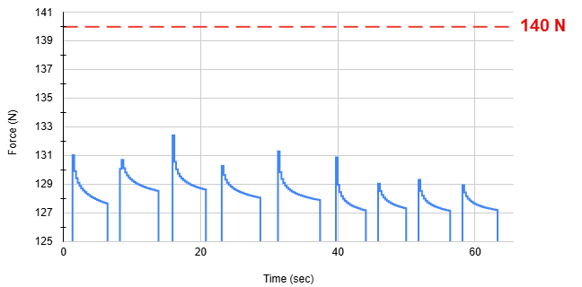
Figure 1: Time-History of Quasi-Static Grip Force — Hand and Finger Simulation
- Test Results and Observations
- Experimental results confirm that the Robotiq Hand-E Gripper maintains a quasi-static grip force below the 140 N threshold when equipped with standard overmolded fingers.
- The Hand-E respects the ISO 10218-2:2025 and may be used in a Power and Force Limiting (PFL) collaborative application.
- Important Considerations
- The compliance result applies only to the tested configuration with default fingers.
- Variations in fingertip shape, material, or sharp edges may affect results.
- A full risk assessment must always be performed for each application.
Conclusion
The Robotiq Hand-E Gripper, in its tested configuration, complies with ISO 10218-2:2025 for Power and Force Limiting (PFL) collaborative applications. This confirms its safe integration in collaborative environments, assuming proper application-specific assessments are conducted.
Need help? Contact Robotiq Support
Updated: January 2026